The World According to Thebe Magugu
How a boy from Kimberley became the architect of Africa's most intellectually charged fashion house.
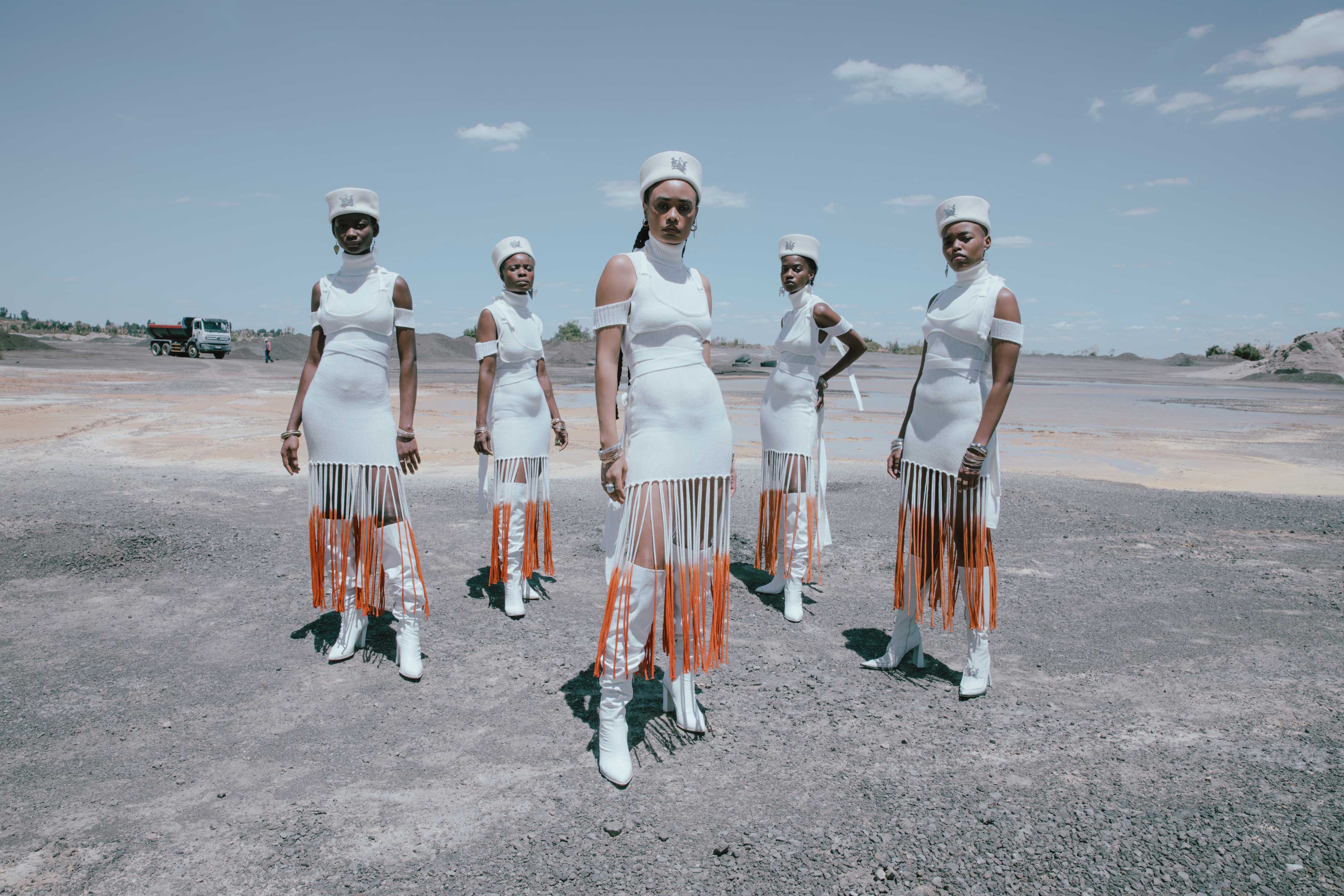
There is a town in Lesotho called Mafeteng. It sits in the lowlands of the Mountain Kingdom, ringed by the kind of sky that seems to belong to no particular century. It is not a place that fashion magazines have written about. It is not on anyone's mood board. And yet, in April 2026, it became the conceptual heart of one of the most talked-about capsule collections to emerge from the African continent a bone-white dress and a kite-shaped cap, named after the town, fronted by media personality Bonang Matheba, and designed by a thirty-two-year-old from Kimberley who has spent the better part of a decade turning quiet, specific South African truths into global luxury fashion.
That designer is Thebe Magugu. And the story of how he got here from a working-class Northern Cape city to the permanent collection of the Metropolitan Museum of Art, from a graduate show to the LVMH Prize jury room, from his mother's living room to a 32,000-square-foot flagship in Dunkeld, Johannesburg is a story about what happens when a designer refuses to simplify themselves for international consumption.
Afro-Encyclopaedic Fashion

Magugu has a phrase he returns to when describing his practice: "Afro-encyclopaedic fashion." It is a strange and precise formulation. Not Afrocentric. Not African-inspired. Encyclopaedic. The word implies comprehensiveness, rigour, the kind of cultural documentation that does not cherry-pick the picturesque but insists on the full picture history and politics, mythology and gossip, grief and glamour. It is a fitting description for a designer who launched a collection about South African intelligence agencies, who has commissioned academic essays on lobola negotiations to accompany garments, and who built a publishing arm Faculty Press specifically to document the contemporary African cultural moment through writing, photography, and art.
This is not fashion as decoration. It is fashion as argument.
Magugu was born in 1993 in Kimberley, the Northern Cape city famous for its diamond rush and its Big Hole a monument to extraction, to the colonial logic of taking everything and calling it progress. He grew up surrounded by women: his mother, his aunts, the matriarchs who shaped his early understanding of beauty as something functional and self-determined. He has said repeatedly that his brand is, in many ways, an homage to those women not as romantic subjects but as full human beings navigating a complicated world with style and intelligence. When he moved to Johannesburg to study fashion design, photography, and media at LISOF, he won the best graduate collection prize. He then spent two years working within the industry before launching his namesake label in 2016.
The Prize That Changed Everything and Nothing
In 2019, Thebe Magugu became the first African designer to win the LVMH Young Fashion Designer Prize. The prize which comes with €300,000 and a year-long mentorship from the LVMH group had existed since 2013 and had launched or amplified the careers of some of contemporary fashion's most important voices. That an African designer had never won it before Magugu said something about the industry's geography of attention. That Magugu won it at twenty-five said something about the speed at which his vision had crystallised.
South African President Cyril Ramaphosa wrote to congratulate him, noting that "the level of consciousness he brings to his artistry is most inspiring and distinguishes him from his contemporaries." Vogue covered it. Business of Fashion covered it. The industry, briefly, turned its attention south.
But what was revealing was what Magugu did not do with the windfall. He did not relocate. He did not pivot toward a more internationally legible aesthetic. He did not begin making the clothes that Paris or New York assumed Africa should make. Instead, for his debut collection at the Palais de Tokyo titled IPOPENG EXT. Anthro 1, named after the township he grew up in he shot photographs in his mother's living room and featured his uncle on a motorbike. He described the collection as "elevated casual" and made the entire work in South Africa. The message was clear: the money had changed his resources, not his coordinates.
The Architecture of a Collection
To understand what makes a Thebe Magugu collection different, it helps to understand its structure. Most fashion houses produce clothes. Magugu produces arguments made from cloth, accompanied by texts, films, and research.
His Heritage series now in its third iteration offers perhaps the clearest example. Heritage III: Lobola Negotiations centred on the traditional pre-wedding negotiation process observed across many South African cultures. Rather than simply borrowing the aesthetic codes of lobola ceremony clothing, Magugu commissioned essays from leading scholars to explain each culture's specific traditions, publishing them alongside the garments themselves. He made a short film. He brought in musician Zoë Modiga as a muse. The result was not a collection but a cultural event one that treated fashion buyers as readers, as thinkers, as people capable of being moved by ideas as much as by silhouette.
Faculty Press, the brand's annual publishing arm, extends this logic beyond any single collection. It has published essays on South Africa's racial dynamics, profiles of queer cultural pioneers, meditations on second-hand clothing markets, and explorations of African folklore. The contributors are writers, photographers, academics, and artists whose work Magugu believes deserves a wider audience. In this, Faculty Press functions less as a marketing tool than as a genuine act of cultural stewardship a designer using his platform to amplify voices the fashion industry would otherwise never encounter.
Mafeteng and the Politics of Homecoming
The Fall/Winter 2026 Mafeteng Capsule Collection arrived in April of this year as something of a summation. The collection draws on Sotho heritage specifically the Seanamarena, the traditional Basotho blanket worn by both men and women, its geometric patterns encoding identity and community in ways that predate any Western design tradition. The pieces include a bone-white dress with subtle structural references to the Mafeteng landscape, a Basotho A-Line skirt, a unisex poncho that recycles an archival Magugu silhouette, and the Kite Cap a headpiece that has become something of a signature.
In choosing Bonang Matheba as his muse, Magugu was making a statement that went beyond celebrity casting. "There is power in knowing exactly where you come from," he wrote in the collection announcement. "I've always felt like Bonang embodies that with remarkable ease, as a woman who has built an entire universe simply around her presence." This is a particular kind of creative logic the idea that a muse is not merely a beautiful body in which to drape cloth but a person whose biography rhymes with the collection's concerns. Bonang, South African through and through, unapologetically herself in every room she enters, is not a neutral vessel. She is an argument.
The choice of Bone White for the hero pieces is equally deliberate. In a collection rooted in cultural richness, the absence of colour creates space for form, for detail, for the garment to carry meaning without the distraction of spectacle. It is a confident move from a designer who does not need to shout.
Building a World, Not Just a Brand
In May 2024, Magugu opened the brand's flagship store Magugu House on a 32,000-square-foot plot in Dunkeld, Johannesburg. The space functions as retail outlet, gallery, community hub, and conceptual extension of the brand's values. It is significant that Magugu chose to build in Johannesburg rather than elsewhere. The city, sprawling and contradictory and alive with creative energy, is the place where his brand took root. To build there is to insist that African luxury does not need to be ratified by a foreign address.
In 2026, this logic extended into hospitality. Working with Mount Nelson, A Belmond Hotel in Cape Town, Magugu designed the Thebe Magugu Suite a space that translates his design vocabulary into three dimensions. The walls are finished in Venetian plaster, a material chosen for its texture, for its memory of Lesotho homes lined with mud. The wallpaper references the rolling hills of Mafeteng. Works by sculptor Nandipha Mntambo whose Xhosa heritage inflects her contemporary practice hang in the space. "I wanted the suite to feel like a capsule that preserves the people who were here before even Mount Nelson," he said. "It should feel like a complete world. A kind of family. Where we come from, where we are now, and where we're going."
This is the ambition at the heart of the Thebe Magugu project: not simply to make beautiful clothes but to build a world that takes African culture seriously as a source of luxury, of intellectual rigour, of emotional depth. A world in which the small town of Mafeteng is as worthy of reverence as the ateliers of Paris.
A Decade In
As the brand approaches its tenth anniversary in 2026, the temptation will be to narrate Magugu's story as a triumph over adversity the African designer who broke through the barriers of a Eurocentric industry. That framing is not entirely wrong, but it misses what is most interesting about what he has built. Magugu has not broken into the industry so much as built a parallel world that operates on different terms terms that privilege cultural specificity over universalism depth over accessibility homecoming over aspiration.
His work has entered the permanent collection of the Metropolitan Museum of Art. A piece from his Folklorics collection was exhibited in the Met's Sleeping Beauties: Reawakening Fashion exhibition in 2024. He has collaborated with Dior on a capsule collection that raised funds for the Charlize Theron Africa Outreach Project. He has been described as "the leader of his generation" by the judges of London's International Fashion Showcase. These are not the achievements of someone who compromised.
And yet the most telling measure of his success might be simpler than any of this: the fact that when Thebe Magugu wants to honour his heritage, he does not reach for abstraction or pastiche. He names a dress after a town in Lesotho. He photographs it in a landscape his family knows. He calls his mother's home a reference point. He insists, quietly and with unassailable confidence, that where he comes from is exactly where fashion should be looking.
In an industry that has spent decades asking African designers to translate themselves for foreign consumption, that insistence is not merely an aesthetic position. It is a political one. And it is winning.