The Fabric of a Nation: Lukhanyo Mdingi and the Soul of African Luxury
How a boy from East London built a Cape Town label that weaves community, craft, and global acclaim into every thread.

The Fabric of a Nation: Lukhanyo Mdingi and the Soul of African Luxury
There is a particular kind of quiet confidence that runs through the work of Lukhanyo Mdingi. It does not announce itself with noise or spectacle. It arrives slowly, the way the texture of a hand-woven fabric reveals itself only when you hold it close through the weight of the wool, the warmth of the mohair, the deliberate looseness of a silhouette that seems to move with human purpose. In an industry that too often mistakes loudness for vision, Mdingi has built something rare: a fashion label that speaks softly and says everything.
Born in 1992 on the East Coast of South Africa, Mdingi grew up in East London, not the fashion-saturated neighbourhood of England's capital, but a small coastal town in the Eastern Cape, the kind of place he has described as "super wholesome, quite wonderful." It was not a city that announced future greatness in design. There were no nearby ateliers, no industry mentors on speed dial, no visible pathway into the elite corridors of international fashion. And yet, something took root early. Like many children of the late 1990s and early 2000s South African television era, Mdingi found his earliest fashion education in the colourful intersection of music and style that programmes like Jam Alley and Selimathunzi offered. Fashion mixed with music seamlessly in those spaces, and something in that fusion sparked an interest that would define his entire career.
In 2011, he relocated to Cape Town to pursue a degree in fashion design at the Cape Peninsula University of Technology, graduating in 2014 with a B.Tech Fashion Degree. A standout thesis collection quickly announced him as a talent worthy of serious attention, landing him a place as a finalist in the Elle Rising Star Design Awards and, shortly thereafter, a slot in Design Indaba's prestigious Emerging Creatives platform. The following year, in 2015, he launched his eponymous label and made his debut at South Africa Menswear Week. The fashion world took notice immediately.
An Aesthetic Built on Conviction
From the very beginning, the Lukhanyo Mdingi label has been defined not by trend-chasing but by deeply held convictions about what clothes should do and mean. The brand is anchored in what its founder calls "muted elegance" an aesthetic of stark androgyny and fluid silhouettes that are inspired by cross-cultural references but speak in a language that is entirely its own. Current yet timeless, the label caters to both men and women, presenting sharply tailored coats and jackets, billowing blouses, and elevated everyday basics that manage to feel simultaneously ancient and utterly contemporary.
Central to this vision is a commitment to premium raw materials. Mdingi has long insisted that fabric is the foundation of design. The label's chosen mediums Angora kid mohair, merino wool, silk, and linen are not decorative choices but philosophical ones. Each material carries its own history, its own sensory language. To dress in these fabrics is to feel something that synthetic alternatives cannot replicate: the weight of real craft, the warmth of something made slowly and well. "Our chosen medium is fabric," Mdingi has explained, "so it's essential that it becomes the cornerstone and foundation of each design." In a world of fast fashion and disposable garments, this insistence on material quality is itself a form of resistance.
But the Lukhanyo Mdingi label has always been about more than beautiful materials arranged beautifully. From the outset, the brand distinguished itself through its model of creation, one that is deeply communal, deliberately collaborative, and rooted in a philosophy of shared authorship. Since its inception, the label has collaborated with artisans and NGOs across the African continent, from weavers to textile specialists, with the aim of making traditional African craft practices visible within the world of luxury fashion. By working with communities that carry centuries of textile knowledge, Mdingi does not simply draw on cultural heritage as aesthetic inspiration he builds structures of economic support around the people who hold that heritage.
The Spirit of the Collective
When Lukhanyo Mdingi accepted the Karl Lagerfeld Prize at the LVMH ceremony in Paris in September 2021, he offered a statement that crystallised the label's founding philosophy: "I've always believed that the power of a collective is far greater than that of a singular, and I think this prize is a testament to that." These were not words of false modesty. They were a precise description of how the Lukhanyo Mdingi brand actually functions, as a community of makers rather than the output of a lone genius.
Nowhere was this more powerfully illustrated than in the label's collaboration with the Philani Nutrition Centre in Cape Town's Khayelitsha township. Philani is an NGO whose mothers and community health workers have long practised weaving as both a livelihood and a form of cultural preservation. In partnering with these artisans, Mdingi created a body of work that was visually extraordinary bold fabrics, dynamic patterns, layered textures but also deeply meaningful in its insistence that luxury fashion and community upliftment need not be separate concerns. The integration of the weavers' techniques into the garments was not superficial. It was structural, and it was acknowledged. The spirit of the collective was, in the designer's own words, "seamlessly woven into the fibres of the garments."
This philosophy of collaboration extended further with the Spring/Summer 2022 collection, titled Bridges. As the name suggested, it sought to build connections between artisans, artists, and communities across geographic and cultural distances. The collection featured handknitting, weaving, and felting, as well as a first-time collaboration with Cabes Gie in Burkina Faso on indigenous dyeing techniques, and a creative partnership with Cape Town-based visual artist Jeanne Gaigher. These were not headline-grabbing collaborations chosen for their celebrity value but genuine, process-driven partnerships that expanded the range of human knowledge embedded in each garment.
Grief, Memory, and the Coutts Collection
Perhaps the most personal chapter in the Lukhanyo Mdingi story is the FW'21 collection dedicated to his late friend and fellow South African designer Nicholas Coutts. Mdingi and Coutts had been close collaborators and friends, traveling together to exhibit at the Generation Africa show at Pitti Uomo in Florence in 2016. When Coutts passed away in 2019, Mdingi was confronted with a grief that was both personal and professional the loss of a creative soulmate at the beginning of what should have been a long shared journey.
Rather than allowing that grief to remain private, Mdingi transformed it into a body of work. "Some people post a selfie, some people write a song, some people journal it," he has explained, "but I wanted to do it through a body of work in his honour." The Coutts Collection was born from this impulse. In an act of extraordinary tenderness, Mdingi learned the weaving techniques synonymous with Coutts' practice directly from the late designer's mother a gesture of artistic inheritance that was also an act of love. "I am so grateful to Nick's family," Mdingi has said. "I would have never been able to create this collection if it weren't for their blessings."
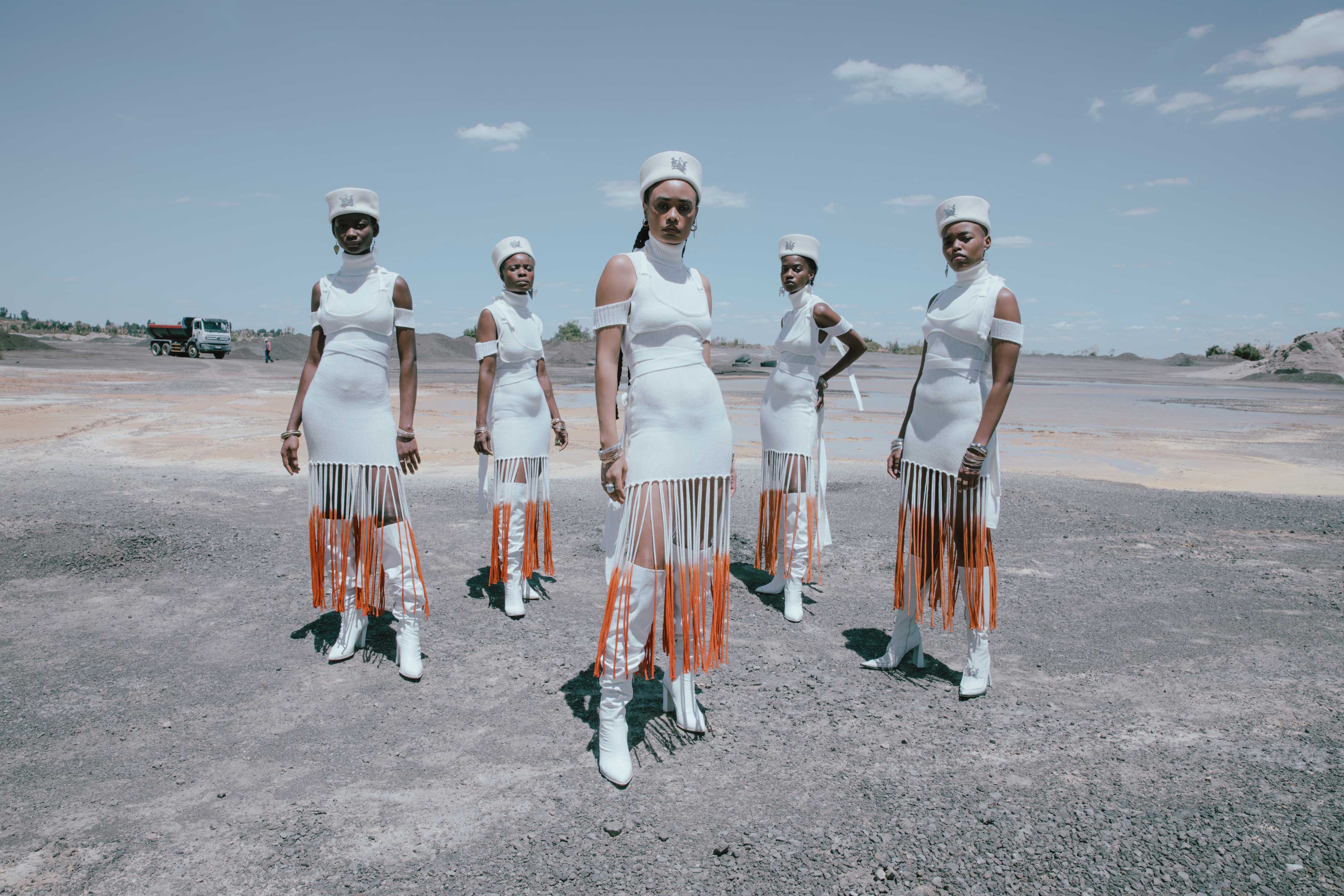
The collection that emerged featuring jersey dresses fringed in wool, sharply tailored suits, and oversized woven shawls was both a visual tribute and an emotional catharsis. Mdingi has described the act of weaving throughout lockdown as meditative, a way of mourning that allowed for reflection and healing. That the collection was ultimately selected to represent the Lukhanyo Mdingi label at the LVMH ceremony gave it an additional resonance: a tribute to friendship carrying a Cape Town brand onto the world's most prestigious stage for emerging designers.
Global Recognition, Local Roots
The LVMH Karl Lagerfeld Prize of 2021 was not Mdingi's first brush with international acclaim, nor would it be his last. By the time the award was announced, he had already been featured in publications including Vogue Italia, I.D., and GQ South Africa; had debuted at New York Fashion Week in 2019 (hand-picked by the CFDA for his forward-thinking vision); had presented on the British Fashion Council's International Fashion Showcase; and had been selected for the NET-A-PORTER Vanguard initiative. In 2022, he was named a finalist for the Andam Prize, and in 2023, he was awarded the Amiri Prize a recognition that came with $100,000 in prize money and a year of mentorship from designer Mike Amiri.
Amiri's words about the partnership spoke directly to what makes the Lukhanyo Mdingi brand so unusual: "Lukhanyo has already done an amazing job of gaining international acclaim and we hope to help him further this. We want to provide him the guidance and resources to maintain his commitment to local craft while at the same time establishing a strong foundation and infrastructure to scale his business." The tension identified here between remaining committed to artisanal roots and building an infrastructure capable of reaching the world is one that Mdingi has navigated with unusual clarity of purpose.
That clarity is rooted in the community he comes from and continues to serve. South Africa has produced a remarkable generation of internationally recognised designers among them LVMH Prize winners Thebe Magugu and Sindiso Khumalo, as well as celebrated names like Rich Mnisi and Mmuso Maxwell. Mdingi both belongs to and has helped constitute this constellation, and his relationships with fellow creatives in Cape Town and beyond have been as formative as any prize or platform. The communal spirit he absorbed growing up in a household he has described as "not necessarily a nuclear family, but there were a lot of women, a lot of love and support" became the organising principle of his professional life. His label does not just employ that spirit as a marketing position; it is structurally embedded in how the brand operates, how collections are created, and how success is understood.
Fashion as Philosophy
At the heart of the Lukhanyo Mdingi project is a refusal to separate aesthetics from ethics, commerce from community, beauty from meaning. The brand's approach to fashion is, in its own way, a philosophical position, one that insists on the connection between maker and wearer, between past and present, between individual expression and collective well-being. Each collection unfolds not according to the seasonal dictates of the fashion calendar but as a narrative shaped by texture, movement, and lived experience. Research, travel, cultural study, and emotional honesty feed into each body of work, giving the garments a depth that outlasts any single season.
This is also, it should be said, a political act. To build a luxury label from South Africa to insist that premium craft lives on the African continent and that the artisans who practise it deserve visibility and fair compensation is to challenge the longstanding assumption that luxury originates only in Paris, Milan, or New York. Mdingi has never made this challenge loudly or polemically. He has made it through the work itself: through garments that speak to the world in the universal language of exceptional quality and through structures of collaboration that redistribute both credit and income.
The Lukhanyo Mdingi brand continues to evolve. Recent years have seen the label expand beyond the runway into exhibition and installation, including the Provenance II exhibition project at The Manor evidence of a creative intelligence unwilling to be contained by a single format. The community of collaborators, buyers, and admirers that has gathered around the label is itself an expression of its founder's convictions: that fashion, at its best, is not a product but a conversation, not a transaction but a relationship, not the work of one but the achievement of many.
To wear a Lukhanyo Mdingi garment is to participate in something larger than oneself. It is to carry on your body the memory of weavers in Khayelitsha, the grief and love embedded in the Coutts Collection, the dye knowledge of artisans in Burkina Faso, and the quiet, steady vision of a boy from East London who believed, against all reasonable expectation, that the world would eventually be ready to listen. It was. It is. And what it hears, when it finally pays attention, is extraordinary.